Contact:
Mike Ferlazzo
570-577-3212
570-238-6266 (c)
mike.ferlazzo@bucknell.edu
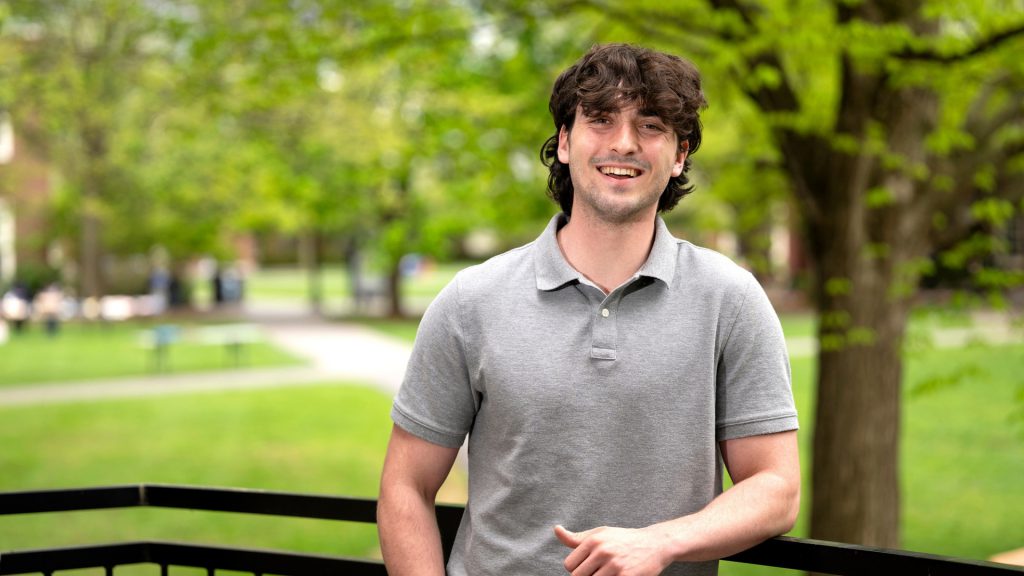
LEWISBURG, Pa. (September 3, 2026) – For Michael Evanick ’28, the path to Bucknell began as an unexpected detour.
A native of Vernon, N.J., he was in Pennsylvania touring Lehigh University when he received a text from a friend encouraging him to stop by Bucknell while he was nearby. Though it was “a bit out of the way,” he decided to visit — and the experience immediately stood out.
“I instantly fell in love,” he says. “It wasn’t even a nice day weather-wise, but I loved the campus. I went on a tour of the engineering facilities, and after learning more about the civil engineering program, I thought it was the best fit for me.”
Evanick’s interest in engineering began early through exposure to the construction industry.
“My dad works construction, and I would go on sites with him all the time,” he says. “He would bring home plans for projects. I thought the process of construction and design for large-scale projects was really interesting.”
In high school, he further explored the field through engineering coursework, including a civil engineering class that confirmed his interest.
“We did some really awesome projects and learned a lot about civil engineering in general,” he says. “I knew that was the path I wanted to go down. And now that I’m here, I think I picked the right path. I love every class I’ve taken so far.”
As a merit scholar at Bucknell, he was introduced to research opportunities before even arriving on campus. While reviewing potential projects during the summer before his first year, one topic immediately caught his attention: stadium structures and how human interaction impacts them.
“I saw ‘stadium structures,’ and I thought that was such a unique thing to analyze,” he says. “I figured, sure, I’ll try that out. It’s been really interesting.”
Working closely with Professor Kelly Salyards, civil & environmental engineering, and the Robert L. Rooke Chair in the Historical & Social Context of Engineering, he has been conducting structural engineering research focused on the behavior and performance of large structures. The experience has strengthened both his technical understanding and his interest in the field.
“There are concepts in my research that I don’t quite understand yet because they’re graduate-level concepts,” he says. “But it’s putting me in a spot where I want to learn more about structural engineering. It’s teaching me that this is something I really want to pursue after I graduate.”
For him, one of the defining aspects of the Bucknell engineering experience has been the close connection between students and faculty.
“That’s something I really liked about Bucknell — the student-to-faculty ratio,” he says. “The connection students have with professors here, especially in my department, is incredible.”
That mentorship and hands-on experience continue to shape his goals. In summer 2026, he interned with global construction consulting firm Whiting Turner in New York City, where he gained experience to prepare for a future career in structural engineering.
-30-
To download full image, right-click and choose “save image as”